- Ruhr-Universität Bochum
Acceleration of CFD-Based Design and Engineering of Pumps
The numerical simulation of unsteady flow phenomena plays a crucial role in the design and optimization of modern hydraulic turbomachinery. In particular, high-fidelity Computational Fluid Dynamics (CFD) simulations provide detailed insights into complex flow phenomena such as flow separation, vortex structures, and unsteady load fluctuations. However, the high spatial and temporal resolution required for these simulations results in significant computational costs, making extensive parametric studies and optimization processes both time-consuming and resource-intensive.
The objective of project SPEED is to develop a comprehensive methodology for significantly accelerating CFD-based design and engineering processes for unsteady pump flows, by combining high-fidelity CFD simulations with model order reduction techniques and parametric interpolation methods, enabling efficient reconstruction of flow fields with substantially reduced computational effort.
In the project, unsteady CFD simulations are first performed using the open-source software OpenFOAM. Both simplified hydrofoil configurations and industrial-scale centrifugal pumps are investigated under various operating conditions, including part-load, best-efficiency-point, and overload operation. The resulting datasets contain high-resolution information on pressure distributions, velocity fields, and vortex structures, forming the basis for the subsequent model reduction process.
Techniques such as proper orthogonal decomposition (POD) are used to reduce the complexity of CFD models. The methodology is illustrated in Figure 1. In this approach, the dominant flow structures are extracted from the unsteady CFD data and represented by so-called POD modes. The essential energy-containing dynamics of the flow can then be reconstructed using a significantly reduced number of basis functions. In combination with the corresponding temporal coefficients, these modes enable the representation of the time-dependent flow behaviour. Based on this framework, a compact Reduced-Order Model (ROM) can be constructed, capturing the physically relevant structures and dynamics of the original CFD flow field while requiring only a fraction of the computational effort.

Figure 1: Schematic illustration of POD-based model order reduction from high-fidelity CFD data. The energy content of each flow structure (mode) serves as a truncation criterion for constructing a reduced-order model with significantly fewer degrees of freedom. Each spatial POD mode is accompanied by a corresponding temporal coefficient that describes its time-dependent evolution.
For the derivation of the ROM, the computed basis functions are incorporated into a Galerkin projection framework. In this approach, the governing flow equations are projected onto the reduced state space spanned by the POD modes. This results in a system with a significantly smaller number of degrees of freedom while still capturing the essential dynamics of the original CFD model. Since classical POD-Galerkin models may lose accuracy in the presence of strongly nonlinear flow phenomena or varying boundary conditions, they are extended in this project by incorporating additional modeling approaches.
A particular focus of the project is the development of parametric reduced-order models. The objective is not only to employ these ROMs at discrete operating points, but also to extend their applicability across continuous parameter spaces. To this end, nonlinear interpolation techniques are developed that enable the transfer of reduced-order models between different operating conditions and geometric configurations.
The interpolation methodology is illustrated schematically in Figure 2 for the simplified case of a single generic parameter. The starting point consists of several locally valid reduced-order models, each derived from CFD simulations corresponding to specific parameter combinations. These models are subsequently embedded in a suitable mathematical space and linked through interpolation, allowing the reduced dynamics of previously unseen operating conditions to be reconstructed without the need for additional full-scale CFD simulations.
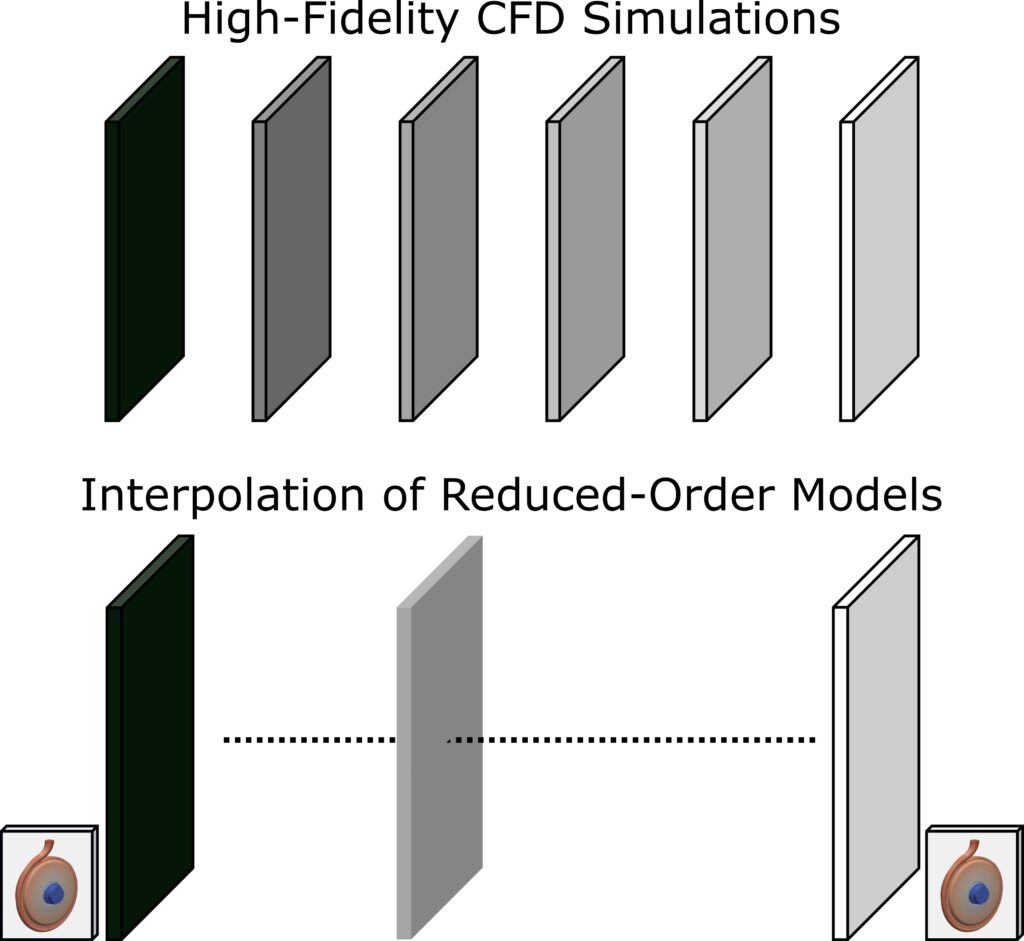
Figure 2: Schematic representation of parametric interpolation between locally valid reduced-order models. The interpolated model enables the reconstruction of previously unseen flow conditions and serves as a computationally efficient surrogate for costly full-order CFD simulations.
Particular emphasis is placed on investigating the accuracy and stability of the reconstructed flow fields. The objective is to obtain robust reduced-order models that remain both temporally stable and valid across a wide parameter range. This enables the rapid evaluation of different operating conditions and the efficient execution of parametric studies.
The developed methods are validated through comparison with fully resolved CFD simulations. Both the reconstruction accuracy of the flow fields and the achieved reduction in computational effort are quantitatively assessed.
The research project addresses the transfer of modern model order reduction and interpolation techniques to complex unsteady pump flows. By developing efficient surrogate models, CFD-based design and optimization processes can be significantly accelerated. This will facilitate a more economical application of numerical flow simulations, particularly for small and medium-sized enterprises.
The work is carried out in close collaboration with the chair of Hydraulic Fluid Machinery (HSM) at Ruhr University Bochum.